
How to recognize an emergency?
Nature is waking up, and we're spending more and more time outdoors – and so are our pets. Because of longer stays outdoors and walks through populated areas, pets start running into all sorts of problems: sometimes they eat something they shouldn't, catch a disease, or simply get injured. It's very important to spot the cause of a change in an animal's behavior in time and react accordingly, since some problems can become life-threatening. Still, not every condition is an emergency, so owners should learn when to react immediately and when a condition is just a passing irritation. We talked about this with veterinarian Vukašin Kosanović at his clinic in Laćarak, who says he has his hands full, and that because of emergencies he's started work as early as 3:30 in the morning.
Although prevention should be carried out year-round, owners usually only start in late spring. Instead of never treating certain conditions at all, we now end up treating them earlier and earlier. Tick and flea problems have already started. We should already be giving protection in February for March, but owners sometimes only get around to it in April, the vet explains.
Dog owners very often contact a vet without knowing how to recognize their dog's condition, which is completely understandable, but it's very important to ask a professional. That's why owners need to be shown what some emergencies can look like, and Kosanović shares one recent situation from his clinic.
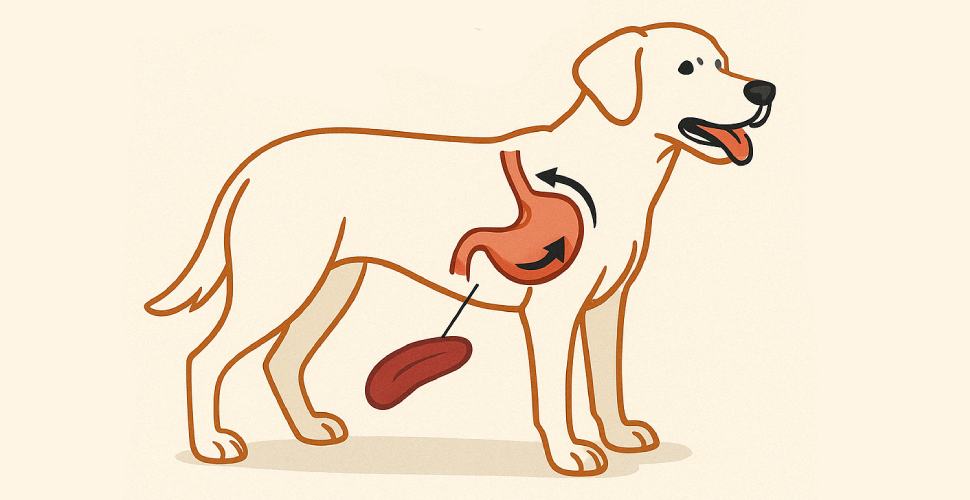
An owner has to be aware of their animal's characteristics, depending on the breed. It's not the same having a Great Dane, a Labrador, or a Pekingese and a Chihuahua. Large dogs with a deep chest, such as the German Shepherd, the aforementioned Great Danes, and Labradors, are at higher risk. Owners usually feed their dogs once a day, which is fine, but they must not take them out for a run or to training right after feeding. After eating, a dog needs to rest for two to three hours so the food can be digested. Otherwise, gastric torsion and dilation can occur – an enlargement of the stomach, often a combination of the amount of food, gas, and physical activity. When sudden movements occur during jumping or running, the stomach can twist around its own axis. This is a genuine emergency, since the only way to get a dog out of such a state is through surgery. It comes on acutely and suddenly – the dog becomes restless, struggles to breathe, tries to sit up with its head raised, and tries to take the pressure off its diaphragm so it can inhale. The condition worsens, and the mucous membranes often turn pale. The owner may notice that the dog's abdomen is visibly bloated. In any of these cases, you need to contact a vet immediately, because it's a matter of hours – the animal can die within two hours. The problem is that this usually happens in the evening or at night, when most vets aren't working. Owners typically feed their pets around eight or nine in the evening. Most vets don't even deal much with this condition, and an X-ray is essential for diagnosis. There it's easy to see what's going on. It looks like a "Smurf hat," as some would call it – it's really distinctive. The stomach becomes overfilled with gas, which shows up clearly and is easy to spot, but it has to be resolved surgically. These surgeries are often expensive, but if the animal gets to us in time, the survival rate is high, says our interviewee.
As for diagnostics, "Sirmiumvet" is fully equipped with the necessary machines and devices. Vukašin himself is a strong believer that a dog must undergo proper diagnostics, especially when it comes to internal medicine.
This is also my favorite part of the job – the internal medicine side, making diagnoses, solving puzzles, because every dog is a puzzle of its own. Vets often don't give owners a diagnosis, for several reasons. An owner can request the history and course of treatment, which vets tend to avoid. It takes up a lot of their time, and some vets are afraid to stand behind what they've given if they'd have to face the question of whether they reached the correct diagnosis. The problem is that owners expect a diagnosis within the first five minutes of arriving at the clinic, which isn't possible. Nor is it responsible. Owners expect the situation resolved without prior diagnostics. They often value more highly those vets who take the approach of glancing at the dog and immediately saying "that's what it is." Proper diagnostics need to be done, and often, in trying to meet owners' wishes, we're forced not to do it, because unfortunately it always comes back to the matter of finances and limited budgets, Kosanović said.
The conclusion is that before adopting or buying a pet, dog owners need to seriously and thoroughly familiarize themselves with its nature. Raising a dog also brings numerous responsibilities, since the animal's life sometimes depends on the owner's approach. An informed owner and dedicated attention are the right path to raising a healthy and happy pet.
Veterinarian Vukašin Kosanović says he's always open to cooperation, and his phone number is always available to owners who have a dilemma or a problem. The clinic is located in Laćarak, at 1. Novembra Street, and the contact number is 0617208663.